Today we'll start a new routine for us: a video, reading, or listening about a current event or issue and a comprehension/critical creativity exercise to explore that understanding.
We're going to review sketchnotes quickly and then take ten minutes to sketchnote this video from the actor, Mahershala Ali, who won a Screen Actors Guild award yesterday for his performance in the film, Moonlight.
How might we capture the essence of what Ali is saying via a combination of word and image? Take pics of your sketchnotes. You'll be putting them up on your class blogs during our station work. We'll have a ten minute or so discussion of his ideas.
STATIONS.
THREE Key Stations Today.
1. Three Songs of Myself. You'll have twenty minutes to complete this work described in this FlipGrid.
2. Blog Set Up. I'll sit with this group and make sure everyone has their class blog set up and has figured out how to post content to their class blog. I'll also help folks get links to their blogs going on the blog tracker. The what? Yup. During that station.
3. Roots 9. The other stations are pretty intense. This one will be a bit more mellow. Roots 9 will simply be digging into the Roots 9 terms on Quizlet (check the links in the sidebar here) and then making sure you're also reviewing Roots 6-9 for the Quiz NEXT WEEK.
SHOW YOUR WORK
Blog. Finish the Songs of Myself work and get it posted on your blog.
Today we will continue designing for the characters of The Hours and run a design sprint featuring 8 Box, storyboarding, and feedback.
What does a design sprint look like? I didn't invent it. It's a fantastic technique used by designers of all sorts. We're adopting our own version but you can see more of it in the book Sprint by Jake Knapp and the Google Ventures crew.
We ran an 8 Box on Monday. We're going to do another. (The more you 8 Box, the better you get at it.) Then we'll storyboard (3 post its that show your idea in action). We may or may not have time for feedback on our storyboards. We may do the feedback on 8 Boxes.
From here, you'll actually build your prototype solutions to the challenges and needs facing one of the characters from The Hours.
You'll have about 20 minutes to build.
SKETCHNOTING & POWER QUOTING: DALLOWAY 3-29.
We use the last third of class to explore sketchnotes and visualizing as a means of notetaking and annotating a text. We'll look at Clarissa, Rezia and Septimus, as well as discuss the value of meeting other Londoners in Woolf's narrative.
OUT OF CLASS WORK.
SUBMIT.
Synthesis Essay #1
Put a Google Doc in your AP LIT IN folder.
DUE. Today.
BLOG.
Critical Creativity Challenge: Scoring Dalloway. Create an original score for pages 3 - 29 of Mrs. Dalloway using either live instrumentation, Garage Band, SoundTrap Wolfram Tones, Beat Lab, or another online/digital music generator/creator.
Analytical Post: Make a case for or against the presence of Foster's vampires in The Hours. Use text evidence to support your assertions.
DUE. Friday. 10.7.2016
READ.
Mrs. Dalloway. 30-58.
Sketchnote. 3-58.
How might you organize these sketchnotes? How might you make visual meaning of this first quarter of the book? All one? A series? Organized by character? Setting? Idea?
Last week we started our year long theme, though I didn't say anything about it being our year long theme because . . . uh . . . I'm not sure why. But I didn't . . .
Who Am I (at the Moment) and Who Do I Want to Become is all about exploring our identities, our personalities, our values, our abilities, as they are right now, determining who we want to become in the future, and asking the most important question: how might we get ourselves from here to there?
Last week we looked at our multiple intelligences and our mindsets.
We used this survey from LiteracyWorks to help determine our multiple intelligences and took screen shots of our results. Here's an example:
Later in the week we examined to extent to which we have growth and fixed mindsets. We started by looking at objects in the room that represent how we feel about our intelligence. We each chose one, took a picture of it that highlighted how it represents our feelings, and then put it back.
We watched this video that helps explain the difference between the two.
Two of the three classes did some work with scenarios, looking at how someone with a growth mindset would respond to a situation vs how someone with a fixed mindset would respond.
We took screenshots of the results again. This time, however, we also found a sentence from the results that we believe describes us very well -- the inventory nailed it -- and a sentence that we were not so sure accurately describes who we are -- ehhhh..not sure sure about that one- -- and put those sentences in a Google doc.
To bring it all around full circle, we then wrote about how the object we found at the beginning represents our mindset -- whether fixed, growth, or somewhere in the middle. We put that on a Google doc and then some folks started to copy and paste that information to their blogs.
Here's a sketchnote of how we went about doing this work.
If you were able to get all of this work done in class last Thursday and Friday, you did not have homework. Otherwise, you needed to finish completing the survey, finding the sentences that describe and do not describe your mindset, and then explain how that object represents your mindset.
It should be on a Google doc and placed in your English 9 IN folder.
Also in your English 9 IN folder should be your super power/kryptonite writing.
Now . . . Monday and Tuesday . . .
Tuesday may look a little different but here's what happened on Monday . . .
We explored the basics of sketchnotes!
Then we worked with poetry Jenga and created a few poems in the moment.
Then we started reading "So What Are You, Anyway?" by Lawrence Hill, a story about a young woman on a plane dealing with some less than kind fellow travelers. I explained how the Notice/Wish/Wonder graphic organizer works.
Then we broke into 4 Stations, each of which are described on the sketchnoted signs below with instructions. Anything that was not completed in class became homework due at the next class.
We will have six stations through which to work today. Some will have specific spaces associated with them. Others may be done anywhere in the room. Try new perspectives and new positions in the room. You might be surprised at how a change of scenery can influence your thinking.
1. No Red Ink: Commonly Mistaken Words Practice 2 (Quiz Thursday)
2. Speak Ranking Periods 1 & 2: Character SketchNotes (Great Reading, Show Your Thinking & Creativity work)
3. Roots 6: Quizlet (Quiz Next Thursday)
4. Comparison Matrix: Merriweather, McKinley, Mt. Blue (Due tomorrow -- great Reading work)
5. Blogging: Standards, Rubric & Quality Check
6. Mt. Blue Map 2 (great Social Studies and Show Your Thinking work)
7. Speak Ranking Periods 1 & 2: Foreshadowing. Answer this Q on your blog. What could be foreshadowing in Speak? Identify page numbers and power quotes, then explain your thinking. (Great Reading, Voice, Details, and Show Your Thinking work)
SHOW YOUR WORK
Blog.
1+ Posts.
Due. Friday. 12.4.2015
Critical Creativity Challenge: An Art Gallery for Speak.
Visit MOMA.org, Portland Museum of Art, MFA.org or another online art gallery from a gallery that exists in the brick and mortar world (a place people could physically visit) and select three or more pieces of art that you would include in a gallery to represent the ideas in Speak.
We'll began with our thirty circles again as a quick warm up. This led right into the rest of our thinking.
We watched a short news clip about a recent story about a break-in in Maine.
We identified the key points as a class and then set them aside for a moment, while I showed you about these super cool tools from Austin Kleon.
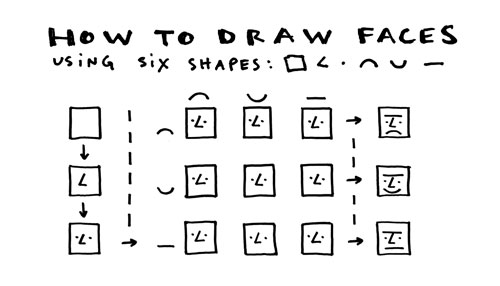
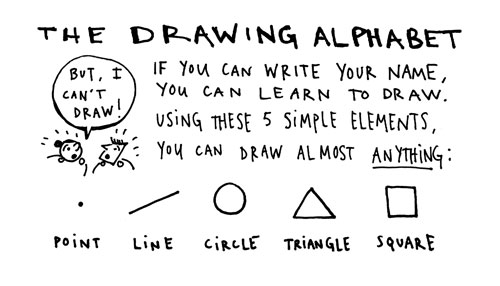
We'll did some work with this alphabet and saw what we can create. I even added an alphabet item or two.
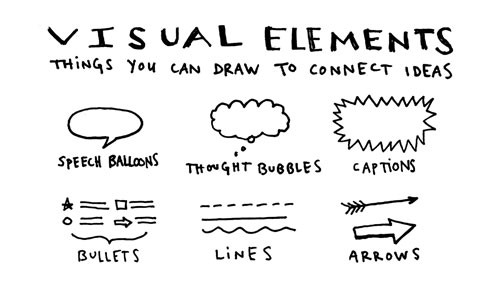
Then we'll bring it back over to the key points and find ways to demonstrate the key points using the visual symbols we can create with the drawing alphabet. We find it incredibly helpful and powerful for people to be able to express their ideas in both words and images -- even if those images are super simple. (Actually, simple images can sometimes do the work of representing an idea much better than complex ones.)
From here, you will be able to choose one out of six readings/listening/watchings to explore using this new set of thinking and demonstrating tools. All of these readings and listenings can be found on our new Google Classroom space.
Stations . . non rotating . . choices . . . follow the sketchnotes below to help you with the process . . starts with a description of each station and then the process follow below.
You'll start with using NoRedInk.com There you will find a new pre-quiz. Take it.
You will also find three new assignments. If you score less than a 90% on the pre-quiz? Complete them.
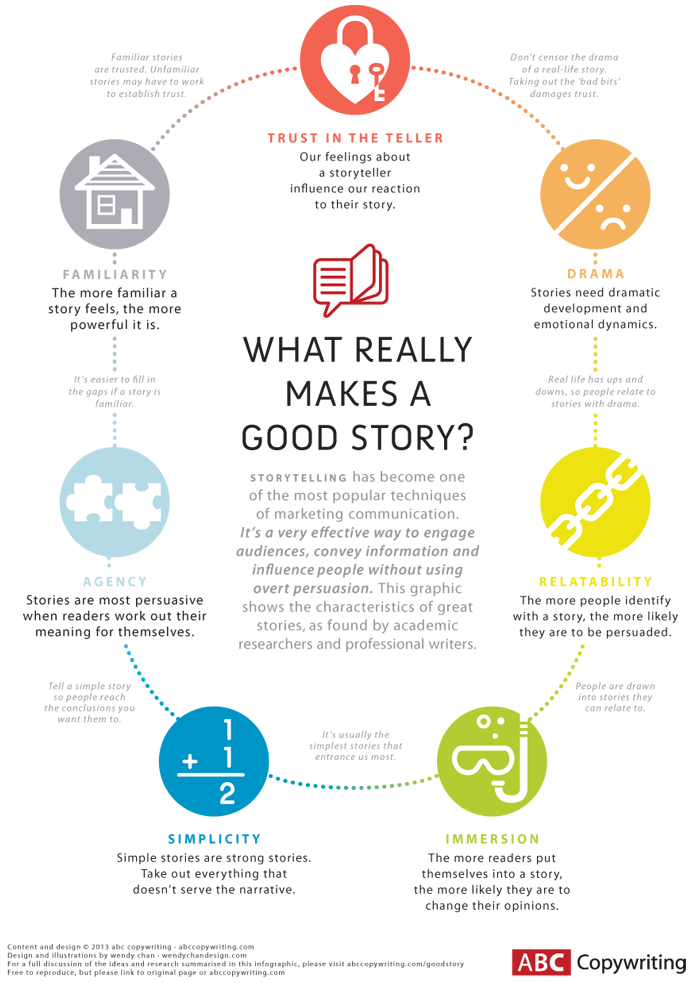
After this, you will be sketchnoting and/or infographic creating. Your topic? According to the sources provided, and others you might look up on your own, what are the vital components of effective storytelling?
Here's one such source.
Here's the link to the others. There are many and I don't recommend going through them in order.
Your sketchnote and/or infographic should include at least three components and no more than six. The intention there is to really focus on what is key -- rather than every piece of advice out there.
If you want to create an infographic, I recommend using http://piktochart.com/ to do your work.
This is due today in class.
When you complete it, you have the rest of the class to finish your Portland Tale which is due on Thursday.
HOMEWORK.
BLOG.
Req'd Post. 5 Card Flickr. Go Here. Use this website and the 5 Card Flickr process to create a 5 Card Flickr about a story from your life that relates one of these emotions: joy, fear, anger, sadness
We'll start with finishing our sketchnotes of the guidelines & expectations for this class, sharing them, and getting ourselves on the same page.
From there we'll take a look at this year's Super Bowl commercials, one of the annual pilgrimages most of the US takes into the world of pop culture.
We'll complete this graphic organizer to get a sense of how these ads function and operate, as well as what values they suggest matter to their audience.
This is all leading to our first design challenge: HMW design advertisements for something we love?
Today we'll set up our blogs. This is will be the primary place where you write and share your thinking in class this semester.
For your first blog entry, write the best paragraph you can -- an example of your best quality writing -- in five minutes. Describe how you spent these past several snow days. Where were you? What did you do? How did you wrangle with the snow?
After this, we'll be creating sketchnotes of the Guidelines & Expectations in groups of 1, 2 or 3. The sketchnote should be based on the information in the packet you were given an answer these questions:
What do we need for class?
What will class be like?
How much work will there be?
Next class we dig into our first text: Beowulf and take a look at boasting and bragging and vanity plates.