Wednesday, September 4, 2013

Humanities: Designing, Boxing, Imagining, Artifacting, Digging Deep

We continue to shape up our learning space today as we do a different sort of work to determine next steps in the space.
Thinking

We'll begin with this video, "Adventures of a Cardboard Box" from Studio Canoe and activity to get us thinking outside the box.


Questions to Answer After Our Watching
  • Why did we have you watch this video?
  • How can what we say affect how other people think about us?
  • What can we learn from our responses to another’s painful experiences?
  • What effect can our jokes have on the people around us?

Artifacts & Humanities
From there we will turn our attention to artifact thinking & critical thinking, digging deep, going beyond the surface as we try to determine what Humanities is all about through evidence.  

Yesterday's artifact work was pretty good.  We can do even better.  
Design
After the artifact work, we return to designing the classroom where we will be using a 2x2 plotting system to help us whittle down all the room design ideas we have going to those we should probably actually put to work in our space.

And then . . . we can start moving stuff around.

Homework
Due Thursday 9/5
Gather artifacts that represent you based on these criteria.

a. One artifact should be about you as a student. 

b. One artifact should be about you socially (family/friends)

c. One artifact should be about your personal interests/hobbies.

d. The last artifact is completely up to you.  

On the sheet provided, write a few sentences about what each artifact says about 

you.  Put all of the artifacts in the brown paper bag given you along with the rationales.  

Put your name ONLY ON THE SHEET.  


Identity Cultural Anthropology Experience:  We will place the artifacts that each of you have brought in 

paper bags. Your job/and my job will be to get one bag, put the items on your desk, take a 

look at them, and then circulate around the room.  Make your best guess as to who belongs 

to each set of artifacts and why you think that.


PACE: Designing, Interviewing, Mapping, Prototyping

Wednesday's class is going to make some tremendous headway for our classroom design.
Design
We will start with Thirty Circles again to warm up the brains.

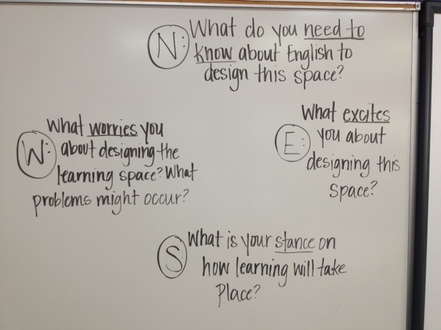
Then we will interview one another using the Four Compass Points protocol, a way of asking key questions about a problem you are trying to solve and finding out what your partner thinks about that problem.

From there, you can choose the design work that most appeals to you:

Organizing & coding the input from the various sources

Drawing/constructing models of the classroom based on the data available

Prototyping and physically experimenting with configurations in the classroom

The above will take about 45 to 50 minutes.
What Is PACE?
The rest of class will be a discussion of what PACE is, what it means, what is going to happen this year, and what each of us needs for this to be successful.  This will mean "norms" work a.k.a. "how we roll" work.

Homework
We will be working a great deal with symbolism, metaphor and analogy this year.
Bring three objects with you to class:
One represents yourself as a learner
One represents what you are thinking about PACE right now
One represents what you hope to gain from PACE
Be prepared to discuss, defend, praise your choices.

Tuesday, September 3, 2013

Humanities: Designing, Artifacting & Naming

We are going to continue shaping our room into a premiere thinking and learning space today.

Designing
We'll start with another round of Thirty Circles to get the brains flowing. 

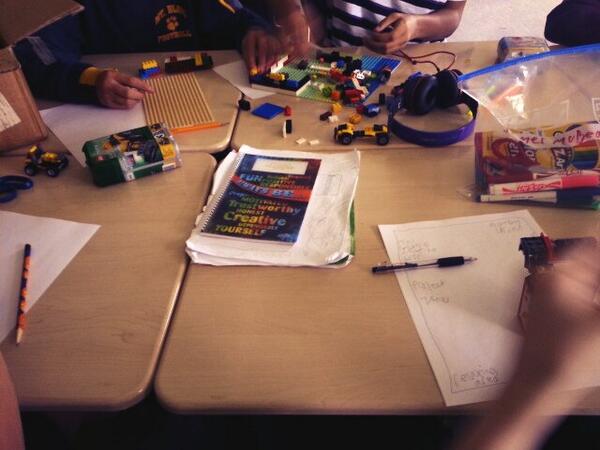
From there, we will draw maps and construct Lego models of our new space.  These maps will go up on the wall and will help determine the best ideas for our space.


Cultural Anthropology

This leads us to the MakeSpace where we will be working with cultural artifacts and practicing our cultural anthropology skills.  Four tables will feature a number of artifacts.  Using your observation, inference and deduction skills to make hypothesis about who you believe owns each of those artifacts, Mr. Ryder or Mr. Dunbar. 


Homework
Due Thursday 9/5
Gather artifacts that represent you based on these criteria.

a. One artifact should be about you as a student. 

b. One artifact should be about you socially (family/friends)

c. One artifact should be about your personal interests/hobbies.

d. The last artifact is completely up to you.  

On the sheet provided, write a few sentences about what each artifact says about 

you.  Put all of the artifacts in the brown paper bag given you along with the rationales.  

Put your name ONLY ON THE SHEET.  


Identity Cultural Anthropology Experience:  We will place the artifacts that each of you have brought in 

paper bags. Your job/and my job will be to get one bag, put the items on your desk, take a 

look at them, and then circulate around the room.  Make your best guess as to who belongs 

to each set of artifacts and why you think that.
AP Lit: Designing, Guiding, Expecting, Sharing, Uniting, Ending

A tremendous amount to accomplish in a very short amount of time, these first two classes of the week.

Essential Question: Why Study Literature?

Sub EQ's:

  • How do we define literature?
  • How do we study literature?
  • How can our space help us to better understand literature?

I will hand you a selection from How to Read Like a Professor that you are to close read and be prepared to apply and discuss next class.


Design
We'll start with the continuance of our design project by completing the Four Compass Points interview process.  During the interview, you will learn about your fellow classmates and what needs they have for this space as a place to study and understand literature, as well as problem solve, collaborate, and enjoy themselves.  This interview, along with your other observations and the ideas upon the walls, will inform the design work you will complete for homework: a diagram/model of the room as you believe it would best function.


Guidelines & Expectations
From here we will take some time to discuss the course guidelines & expectations.  You receive so much of this material in the first week of school, I prefer to save it for the second.  
Preview of Our Guidelines & Expectation


During this session we'll also talk about class norms: the behaviors and understandings we each need from one another in order to function well as a problem solving team.  I like to think of it as "How We Roll . . ."

Sharing Projects
Another round of summer project sharing.  I'll be asking folks to get ready for this during our Guidelines & Expectations conversation.  We can multitask like that, right?


Uniting Great Expectations & Empire Falls
I've begun assessing summer essays and I thought it might be helpful to the revision process if we explored some of the connections between these two works.   


Ender's Game
Today I assign the first one hundred pages of Ender's Game to be read for the first class of next week. We'll sign those out of the library to end class today.  This title is going to be our chief point of discourse around our essential question.  


H/W
Read: Ender's Game page 1-100 - Due 1st Class of Next Week (9th/10th)
Close Read: Intro to How to Read Like a Professor - Due Next Class (5th/6th)
Close Reading includes annotations: what you notice, questions you have, connections you can make
Design: Map/Visual of the classroom as you believe it would best suit the classes' needs - Due Next Class (5th/6th)

Monday, September 2, 2013

AP Lit: Video Tutorial: How to Read Mr. Ryder's Comments

Here's a quick little video tutorial so you understand what I'm doing when I make comments on your work.

Quick Text Version

Handwritten comments:
Solid line = positive  (more lines mean more positives)
Wavy line = constructive criticism needs to be addressed
Handwritten comments = a mess and likely demand to be translated into human-based language

Google Doc comments:
Light blue highlight = positive
Gray highlight = typo
Comment = constructive criticism that needs to be addressed

Pages/Preview comments/annotations:
Same as Google Doc


To post as a Google Doc after writing in Pages, simply cut and paste your work into a new Google Doc and share with me on Drive in your [Student Name] AP Lit IN Folder you will be creating on Drive


Friday, August 30, 2013

Humanities: Empathy & DEEP Design

We continue our design thinking work by looking at Casey Neistat's filmmaking & his studio.

Make It Count from Casey Neistat on Vimeo.

GIZMODO - The Wildly Functional Studio of Video Wizard Casey Neistat, Part 1 from Gizmodo on Vimeo.

Then we will take a moment to get a working definition of "design thinking" going here in the room. We will be using Mary Cantwell's DEEP Design Thinking process.


  • Discover
  • Empathize
  • Experiment
  • Produce


Yesterday's See, Think, Wonder work was part of the Discover process.

Today we move into Empathize.

By considering the purpose and function of a space, we can better add design elements to help the user.  Thinking about the user and understanding what that user needs and all the ways that user might work within a space relies upon our EMPATHY skills.

We will use The Compass Points protocol to help us in this.
From http://jillianhinesley.weebly.com/design-thinking.html


We will interview one another, asking these four questions in order to better understand what we each want from this space.  This data we can use to make better decisions about the design we create next week.

We will then get into groups to discuss each of the points and what we have learned about each of us.


Thursday, August 29, 2013

Humanities: Room Design Day One of ?

We kick off our room design process today.

Before we get to that, however, we want to wrap up our mini-work with Langston Hughes' "Harlem."  We will be discussing cause, effect, dreams, goals, wins and fails and completing a short analysis activity of the poem called a "Chalk Talk."

And then . . .

Note: Everything below is copied from the AP Lit blog entry from today.  Why? Because Humanities & AP Lit are following the SAME PROCESS!  9th graders & 12th graders doing the same work?!! What is this madness?!?

From here we will do a few community building activities -- two quick ones and start a much more involved process: designing our space.

Each of the above will provide us an opportunity to dive into DESIGN THINKING, a human-centered way of approaching problem solving and creating.


Over the next couple of weeks we'll be exploring the ideas presented by David Kelley's IDEOStanford d.School & Mary Cantwell's DEEP Design Thinking.

For today though, we will be taking a page from Jillian Hinesley's work and shaping our learning space.  We will follow the "See, Think, Wonder" learning routine.

John Stuart Mill: Huge Fantasy Football Nerd.
Each of my classes will be doing this and we will follow a process to choose the best of the best ideas to create a John Stuart Mill room, achieving the greatest good for the greatest number of students.  We'll be collecting observations of our space's use, assessing its form and function, and revisiting the designs later in the year.

I don't want to give every little nook & cranny away, but that's what will drive our first day.

And since you all worked so hard this summer -- or at least these past few days -- you have a three-day weekend to unwind and reset for our AP Lit Design Thinking/Literary Analysis & Composition Boot Camp arriving next Tuesday & Wednesday.

Don't forget: Designer Starter Kits!  Get them in ASAP!